
Michell • TecnoDec Integrated Turntable
Back in the early 1990’s, when I was an aspiring audiophile and my record collection was probably no more than 100 titles in size, I bought a CD player: I’d succumbed to the CD “Perfect sound forever” hype being espoused by most of the hifi press at the time. I remember thinking that the first CDs that I played sounded unnaturally bright, but convincing myself that they must be correct because they were digital. This was despite reading columns in the specialist press, like The Absolute Sound, about analogue’s superiority, especially those written by Michael Fremer.
Within about a year, I attended my first hifi show. In one of the Absolute Sounds’ demo rooms, they had a big system: a Krell CD player, a Krell four-chassis preamp, a pair of huge Krell MRA Master Reference Amplifier monoblocks driving a pair of Apogee Diva speakers, and a Goldmund Studio turntable with (I think) a Koetsu Red Signature MC cartridge. The salesman introduced the gear, finishing by saying that he was going to alternate playing tracks on CD and vinyl. I remember commenting to my friend who had come to the show with me that playing vinyl seemed to be a bit stupid given CD’s obvious superiority.
I should add that at this time I was not a sophisticated listener, so when the CD played and had very impressive bass and treble, I thought that my opinion had been vindicated. Well, that thought was destroyed the minute the first vinyl record track was played. What was this? Bass and treble sounding as good as a CD from a turntable? My reality shaken with this new data, I decided that after the show I would have to revisit my CD buying decision (thankfully I had kept nearly all my vinyl records!).
With that in mind, I sought the help of my local hifi dealer. He was a home-based business and was willing to lend me a turntable, arm, and cartrdige for a week or so. At the end of my evaluation, I couldn’t ignore the evidence of my own ears and vinyl’s audible superiority, so I decided to sell my CD player and persue an all-analogue audio future. The turntable that was instrumental in my decision was the then entry level turntable from Michell, the Syncro. It is the Syncro’s direct descendent, the TecnoDec, which is the subject of this review.
Technical Details
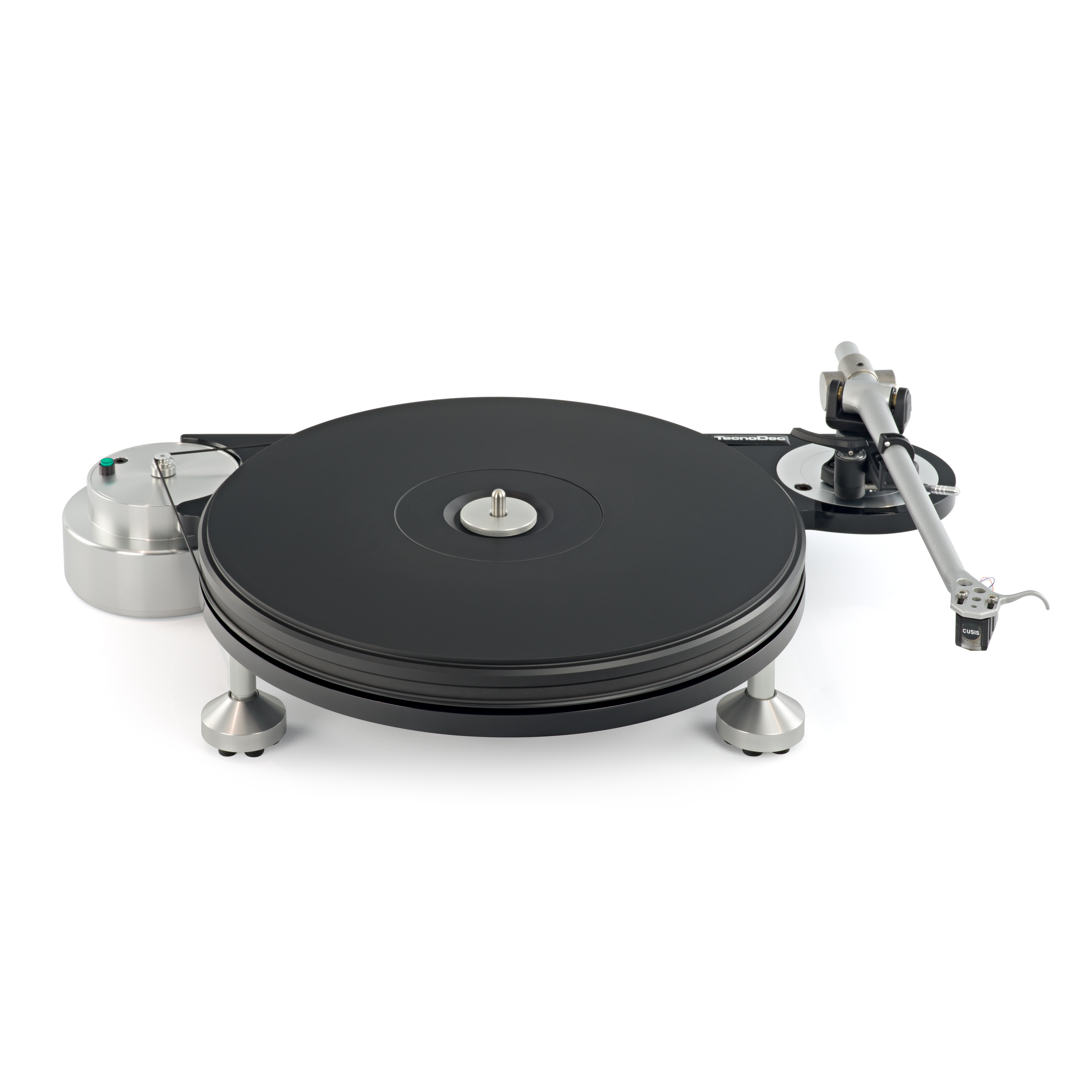
The TecnoDec is Michell’s entry-level turntable. It is a suspensionless, belt-driven integrated design, which shares many features developed for its big brother, the GyroDec. The TecnoDec’s plinth is made from black extruded acrylic and has three adjustable feet, each of which has a Sorbothane foot designed to isolate the turntable from structural vibration from the supporting surface. Fairly atypical for this price point, the motor unit is free-standing and machined from a single billet of aircraft grade aluminium.
The motor unit, which is powered by an external wall wart power supply, is designed to minimise vibration transfer to the platter while the motor is running: when in operation, the only connection between the motor and the rest of the turntable is the drive belt. Talking of which, the speed is selected by moving the drive belt from one pully to the other. It’s no secret that I’m not a fan of wall warts, but to their credit Michell do offer the HR Power Supply (which I didn’t test).
The 25 mm thick platter is made from black Delrin, which was chosen for its vibration damping characteristics and because it has very similar sonic signature to vinyl. Designed to be used without a mat, the platter has an indentation for the record label.
Perhaps the most interesting technical aspect of the TecnoDec is the inverted main bearing. Rather than the point of rotation being at the bottom of the bearing (as is the case with most turntables), the TecnoDec’s point of rotation is at the top of the bearing. This arrangement, together with an Archimedean screw that Michell machine into the inside bore of the bearing, allows for the entire inside of the bearing to be fully lubricated while the platter turns. Oil is drawn up from the reservoir at the main bearing’s base to the thrust ball at the top, fully lubricating the spindle as it goes. A hole in the spindle enables the oil to return to the reservoir. Michell say that lubricating the precision parts of the bearing in this manner means that any potential for noise or vibration created by the platter’s rotation is avoided.
The TecnoDec can be supplied with or without a tonearm; the sample I received for review included the Michell T2 Improved tonearm (which had been supplemented with the optional $299.99 TecnoWeight counter weight), and a Goldring E3 MM cartridge.
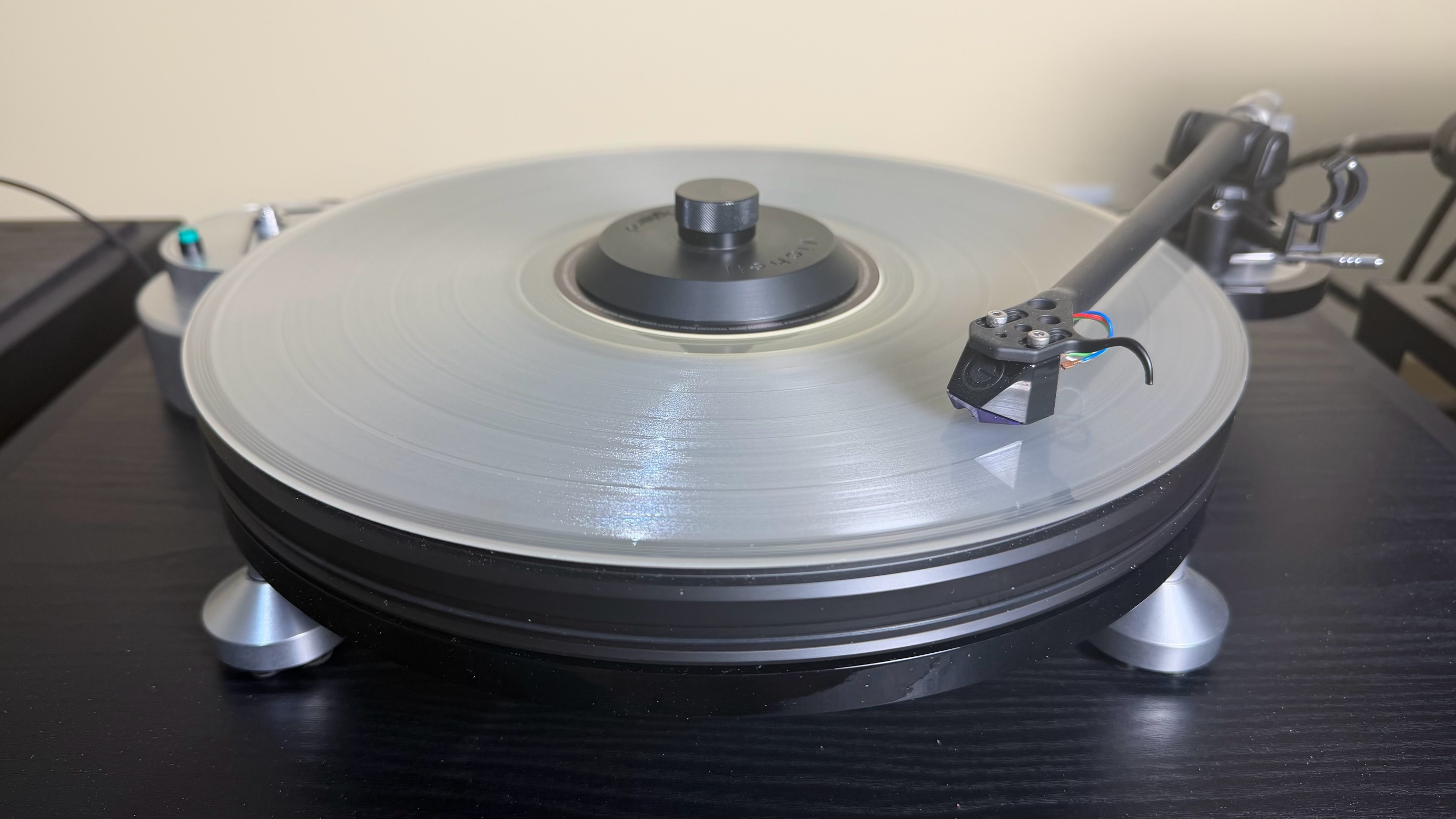
The T2 Improved tonearm, which is based on the Rega RB220 and uses the wiring from the Rega RB880, is Michell’s entry-level offering. It uses a new arm tube and the current three-point arm mounting system. Each T2 Improved is hand assembled to create a tonearm with extremely low friction levels in the bearing. This ensures perfect tracking and maximises information extraction by the cartridge.
The T2 Improved uses new low capacitance phono cables that were developed for the T8 tonearm, terminated by high quality gold-plated Neutrik phono plugs. While I’m talking about the tonearm: one operational aspect I really liked about using the T2 was the damped cueing lever. Just line the stylus up with the track you want to play, pull the cueing arm towards you, and wait for the damped mechanism to slowly lower the cartridge into place.
VTF is set by positioning the counterweight (threaded in the default package but sliding when using the TecnoWeight), and the anti-skate (bias) is set by a slider at the base of the tonearm. The cartridge is unmounted but the arm is otherwise set up at the factory, simplifying set up for audiophiles new to turntables. That said, setting up a cartridge is an exacting art, so it might be best to have your dealer install it for you.
Rounding out the TecnoDec package is the Michell record clamp and the Michell UniCover dust cover.
The TecnoDec’s fit and finish are fine, and I am pleased to note the inclusion of a dust cover. Regular readers will know that the ommission of a dust cover by turntable manufactureres is one of my pet peeves, so kudos to Michell for including one with the TechnoDec.
Setup and Listening
The TecnoDec is not quite a plug and go turntable: some (minor) assembly is required. First place a small amount of oil into the oil well around the spindle, then (after removing the clear cover) gentle place the platter onto the bearing. After it has settled, secure the platter by gently screwing down the platter retainer.
Place the motor unit and truntable on a sturdy, level surface, leaving a gap of about 1 mm between the turntable and motor unit. Then, ensure the turntable is level (in both axes) by placing a small spirit level on the platter and adjusting the three feet as required. Install the drive belt, plug in the power supply, and connect the tonearm arm cables to your phono stage or phono input.
The motor’s two pulleys select the speed: use the upper pulley to select 33-RPM, and the lower one for 45-RPM.
After fitting the Goldring E3 cartridge, I set the tracking weight to the recommended 2.0 g, adjusted the anti-skating appropriately using the tonearm’s little slider, and set my phono stage’s input impedence to 47 KΩ.
To give everything a chance to burn in, I played the TecnoDec for 20 to 30 hours before doing any serious listening.
Sound Quality
If there’s one job that a turntable has to do well, it is to spin at the correct speed with high stability. In this respect the TecnoDec does very well. Another good thing I observed when listening to the TecnoDec was the nice, quiet backgrounds. I listen to a wide variety of music, some of which plays very softly, so the importance of a quiet background can’t be overstated.
Moving on to some specific examples, I started (as I almost always inevitably do) with Mike Oldfield’s Tubular Bells [Virgin Records V2001]. It’s a record to which I’ve listened countless times and with which I am intimately familiar. Definition is quite good, albeit with some (not unexpected at this price point) softening at the frequency extremes, especially in the treble. This was especially noticable with the bells and tinkling piano at the beginning, and the glockenspiel in the finale.
There are lots of little details which make listening to this record a real joy for me, and I'm pleased to report that the TecnoDec reproduced them with aplomb. Sounds had good, but not great, separation. For exaple, the Nasal Choir: I could hear the individual contributors, but they tended to congeal into one locality.
Bass definition is pretty good (although as previously noted, doesn’t quite plumb the depths reached by more expensive front ends). It is fairly deep, tight, and tuneful. An example of this is the bass guitar section introduction to the finale, and in the finale itself.
The next record I auditioned was Shaka Zulu [WEA 925 582-1], South African a cappella group Ladysmith Black Mambazo’s first album on Warner intended for release in the US. The album’s last track, Who Were You Talking To?, has the singers arranged across the stage with clear deliniation between the singers. The singer’s harmonies are nicely reproduced, and the part where the singers stamp their feet has ample heft and one can hear the reverbrance in the studio.
Switching genres, I played a few classical music records. The first of these was Scheherazade by Rimsky-Korsakov [Classic Records/RCA Victor LSC-2446]. The opening harp and solo violin have a lovely, sweet tone, and the orchestra’s width and depth are reproduced well. I hear some conjestion when the orchestra was in full tilt, but I didn’t think it was too serious at this price point.
The next record I listened to was the 45-RPM version of Richard Strauss’ Also Sprach Zarathustra by the Chicago Symphony Orchestra, conducted by Fritz Reiner [Analogue Productions/RCA Victor AAPC 1806-45]. The ~30 Hz low bass rumble from the organ and double bass, kettle drums, and brass fanfare at the beginning, which were made so famous by Stanley Kubrik’s movie, 2001 A Space Odyssey, really took my breath away; this is one track that really demands that the volume is cranked up! The blare of the horns has real heft. Depth is good, but not up there with the best.
Next on the platter was another old favourite of mine: Prokofiev’s Lieutenant Kije [Classic Records/RCA Victor LSC-2150]. Depth definition is good, but not great: the positioning of the off-stage opening trumpet wasn’t as far back and clear as it is on more resolving gear. On the other hand, the opening snare drum can clearly be heard reflecting off of the back right of the hall. The bells in Troika lack a bit of sparkle, but this is offset by their resolution.
The last record I listened to was Dusty Springfield’s The Look of Love from the Casino Royale soundtrack [Classic Records/Colgems COSO 5005-45]. I found that Dusty’s voice had slightly exaggerated sibilances when auditioned on the TecnoDec combination, but sounded convincingly good nonetheless and has an almost-in-your-room quality about it. The brass at the end has good bite.
Verdict
The Michell TecnoDec package combines a well-designed turntable and tonearm with a MM cartridge, in a relatively affordable (almost) plug and go combination. Fit and finish are to a high standard, and the packaging is more than adequate to protect the turntable from the potential dangers of shipping. With the caveats mentioned above, the sound quality is very acceptable.
If you’re in the market for a turntable in this price range, and want to avoid the complexities of turntable setup as much as possible, the TecnoDec package might be just the tickets and should be on your short list for an audition.
Specifications
Description Belt drive, integrated turntable.
Speeds 33.3 and 45 RPM.
Output voltage 3.5 mV (1 kHz at 5 cm/s).
Channel separation > 20 dB (1 kHz).
Channel balance < 1.5 dB at 1 kHz.
Recommended tracking force 1.5 to 2.5 g.
Dimensions (whd) 490 mm x 85 mm x 310 mm.
Weight 4.6 kg (including tonearm and motor).
Finish Black.
Serial number of unit reviewed 1590.
Price CAD $3,999.99 ($4,299.98 as tested).
Warranty Two years non-transferable (five years with registration).
Manufacturer
J. A. Michell Engineering Ltd
Unit B, Gateway 1000
Arlington Business Park
Whittle Way
Stevenage
Hertfordshire SG1 2FP
United Kingdom
+44 (0) 20 8953 0771
www.michellaudio.com
Canadian Distributor
Essentia Technology Inc.
3 Wesleyan Street
Georgetown, ON L7G 2E2
Canada
(647) 553-6535
www.essentiatechnology.ca
Associated Equipment
Analogue source Forsell Air Reference Mk 2 turntable and arm.
Phono cartridge Lyra Atlas.
Phono stage Audio Research PH8.
Line stage Audio Research LS27.
Power amplifiers PrimaLuna ProLogue Sevens.
Speakers MartinLogan Spire.
Cables Phono: Nordost Tyr 2. Interconnects: Nordost Tyr 2. Speaker: Nordost Tyr 2. AC: Nordost Tyr 2.
AC power Dedicated subpanel supplying five 20A circuits using identical lengths of 10 gauge wire; Leviton hospital grade receptacles.
Accessories Target and SolidSteel equipment stands; Mission Isoplat; Audio Physic cartridge demagnetiser; Acoustech carbon fibre brush; Lyra SPT stylus cleaner; Audio Additives digital stylus force gauge; Spin Clean Record Washer Mk II.